Ecological Importance Analysis: Species Relationships, Distribution & AI Reporting
Ecological Importance Analysis: Species Relationships, Distribution & AI Reporting
Learn how to assess the ecological importance of a species using relationship mapping, taxonomic visualization, geographic distribution data, and AI-assisted report generation. Includes workflow overview and export options.
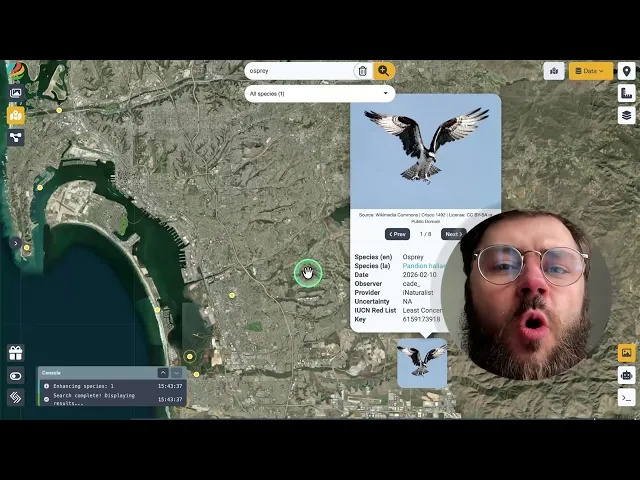
Ecological importance analysis is a method for evaluating the role a species plays within its ecosystem. By combining species relationship data, taxonomic classification, and geographic distribution, analysts can build a multidimensional profile of how a species interacts with its environment. An integrated AI assistant further supports this workflow by generating comprehensive ecological reports from the underlying data.
This page describes the core components of the analysis workflow, using the Osprey (Pandion haliaetus) as a reference species.
Species Relationship Analysis
Species relationships form the foundation of ecological importance assessment. The system represents predator-prey interactions, competition, mutualism, and other ecological links as a structured network. Analysts query this network to identify which species interact with a target organism and in what capacity.
For the Osprey, relationship data reveals connections to predators such as the Common Raven (Corvus corax) and the Eurasian Eagle-Owl (Bubo bubo), along with a broader set of mammalian and avian species. These interactions indicate the Osprey's position in local food webs and its vulnerability to predation pressure.
Relationship data is sourced from curated ecological databases and can be filtered by interaction type (e.g., predation, parasitism, competition).
Taxonomic Customization
The visualization layer supports dynamic adjustment of taxonomic resolution. Users can shift the view between ranks — from phylum down to genus or species — depending on the scope of the analysis. This flexibility serves two purposes: broad-level views reveal ecosystem-wide patterns, while narrow-level views isolate species-specific interactions.
Adjusting taxonomic granularity is particularly useful when presenting findings to different audiences. A high-level phylum view may suit policy briefings, whereas genus- or species-level detail is more appropriate for peer-reviewed research.
Geographic Distribution
Species presence data provides spatial context for ecological analysis. Observation records, tied to specific coordinates and regions, show where a species has been documented. For the Osprey, records include observations across North America, with notable presence in regions such as California.
Geographic data serves several functions within the workflow: it contextualizes relationship data by region, highlights range overlap with interacting species, and supports habitat suitability assessments. Presence records can be displayed as point maps or aggregated by administrative boundary.
AI-Assisted Report Generation
An integrated AI assistant automates the generation of ecological reports. The assistant ingests observation records, relationship networks, and taxonomic metadata, then produces a structured document summarizing the species' ecological profile.
Reports generated through this process typically include the following sections: species overview, key ecological relationships, geographic distribution summary, and conservation relevance. The output is available for export in Word format, and the assistant supports multilingual generation, broadening the accessibility of findings for international collaboration.
This capability reduces the time required to produce client-ready or publication-ready documentation from hours to minutes.
Export and Sharing
Generated reports can be exported as Word documents (.docx). This format supports further editing, collaborative review, and integration into broader research deliverables. Multilingual export ensures that findings are usable across language boundaries without requiring manual translation.
Summary of Capabilities
The ecological importance analysis workflow combines four core components: species relationship mapping, adjustable taxonomic visualization, geographic presence data, and AI-driven report generation. Together, these tools enable researchers, educators, and environmental professionals to assess a species' ecological role efficiently and communicate findings in a structured, professional format.
Analyse biodiversity with Gaia
Open nexus.gaia.eco.
Join our Community Forum
Any other questions? Get in touch