Monitoring the Asian Hornet Threat to European Honeybees
Monitoring the Asian Hornet Threat to European Honeybees
Learn how gaia.eco tracks the invasive Asian hornet threatening European honeybees using crowdsourced biodiversity data, predictive modelling, and citizen science.
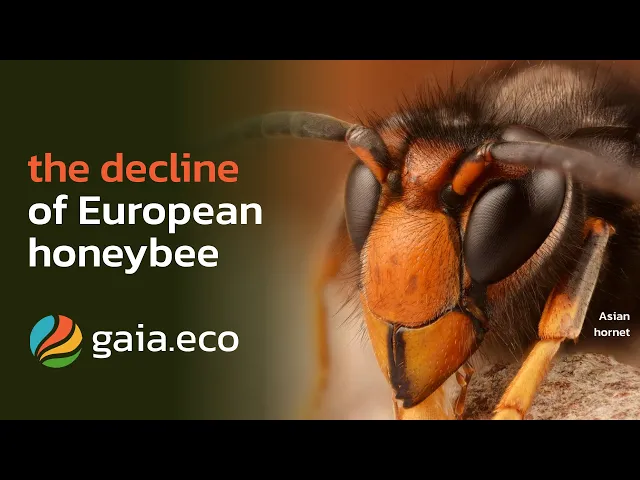
The European honeybee is facing a serious and accelerating decline. Among the most significant drivers is the invasive Asian hornet (Vespa velutina), first reported near Bordeaux, France, and now spreading rapidly across the continent. Without effective natural predators in Europe, the hornet poses an outsized threat to bee populations — and, by extension, to the pollination systems that underpin agriculture and food security.
The Asian hornet is far from the only pressure on honeybees. Invasive parasites such as the Tropilaeleps tick, along with environmental stressors including pesticides and pollution, compound the problem. Addressing bee decline requires understanding and monitoring multiple converging threats rather than focusing on any single factor.
Why It Matters
European honeybees are essential pollinators for crops and wild habitats alike. Their decline directly threatens food production, agricultural economies, and broader ecosystem health. Preserving healthy bee populations is not only an ecological priority — it is a socio-economic one.
While some indigenous European species — including chickens, martens, and buzzards — do prey on Asian hornets, research shows that none of these predators exert sufficient pressure to control the hornet's population. This gap underscores the critical role of human monitoring and intervention in managing invasive species.
How gaia.eco Helps
Gaia.eco provides a platform for crowdsourced biodiversity data collection, enabling researchers, conservation groups, and the public to track invasive species spread and assess ecological impact in near real-time.
Use Case: Predictive Modelling of Hornet Impact
A research team at Prague University used gaia.eco biodiversity data, combined with species interaction research, to build a predictive model forecasting the Asian hornet's impact on European honeybee populations. By aggregating field observations with ecological datasets, the team was able to identify patterns of spread and assess the effectiveness (or lack thereof) of natural predation.
This example illustrates how combining academic research with community-driven data collection enables more accurate and actionable environmental analytics.
Use Case: Multi-Threat Monitoring
Because bee decline is driven by overlapping pressures — invasive predators, parasitic ticks, pesticides, habitat loss — effective conservation requires integrated monitoring. gaia.eco supports this by aggregating diverse biodiversity observations into a single platform, giving researchers a holistic view of the threats facing pollinator populations across regions.
Key Facts
The Asian hornet is an invasive predator causing rapid decline of European honeybee populations, with no effective natural population control in Europe.
Honeybees are critical to pollination, ecosystem health, and agricultural output, making their decline a direct threat to food supply.
Bee decline is compounded by multiple invasive species and environmental pollutants, requiring integrated, data-driven conservation strategies.
Crowdsourced biodiversity platforms like Gaia.eco enable ecological forecasting and support the development of nature-based interventions.
Getting Involved
Individuals and organisations can contribute to honeybee conservation and invasive species monitoring by:
Submitting biodiversity observations through the Gaia.eco platform
Supporting research into nature-based solutions for invasive species management
Reducing pesticide use and promoting pollinator-friendly habitat restoration
Collaborating on citizen science initiatives that strengthen environmental data coverage
Preserving honeybees demands a collective effort — one grounded in reliable data, cross-disciplinary research, and sustained community engagement.
Read a detailed analysis on this webpage done by students from Prague University of Economics.
Join our Community Forum
Any other questions? Get in touch