Search
Biodiversity Data Retrieval | Types of Search
gaia.eco, biodiversity search, species search platform, single taxon search, multi-taxa search, ecological relationships search, internet hashtag search, biodiversity data exploration, species observation map, conservation data tool
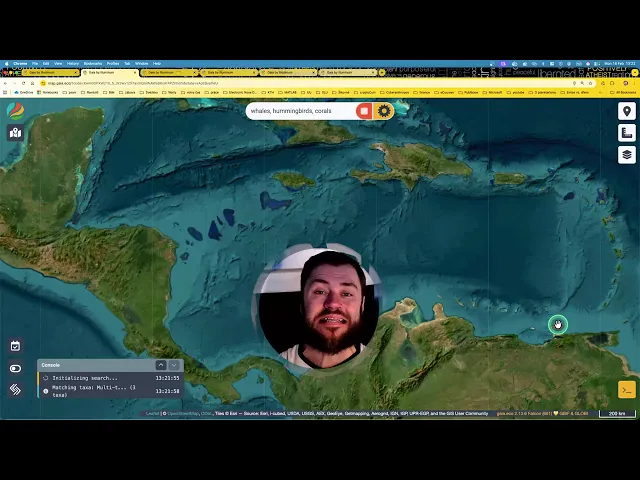
gaia.eco provides four distinct search methods for exploring species observations, ecological relationships, and taxonomic distributions. Each method serves a specific use case, from targeted single-species queries to broad internet-sourced descriptive searches.
This page documents all four search types, their input formats, behaviour, and practical applications.
Single Taxon Search
Single taxon search retrieves observation data for one species or taxonomic group at a time.
Input format: A common name (e.g., "white-tailed eagle") or a Latin scientific name (e.g., Haliaeetus albicilla, querying at the species level or at a higher rank such as an entire class (e.g., birds).
Use case: Targeted biodiversity mapping where the focus is on a single species or a well-defined taxonomic group.
Single Taxon Search with a Relationship
This variant extends the single taxon search by including species with a particular ecological relationship.
Input format: A single species name, with the relationships option selected.
Behaviour: The platform returns not only the queried species but also its ecologically linked species. Results are colour-coded on the map to distinguish between the source species and its related taxa. The underlying data is structured in a source–target format that describes the nature of the interaction (e.g., pollination, predation).
Example: Searching for the monarch butterfly (Danaus plexippus) with relationships enabled returns the plant species it pollinates, displayed alongside the butterfly's own observation records.
Use case: Investigating ecological interactions such as pollination networks, predator–prey dynamics, or host–parasite associations.
Multi-Taxa Search
Multi-taxa search allows querying up to 50 taxa in a single request. Taxa can span unrelated branches of the tree of life.
Input format: A comma-separated list of species names or higher taxonomic groups (e.g., "whales, hummingbirds, corals").
Behaviour: All specified taxa are resolved and their observation data is plotted simultaneously on the map. Each taxon group is visually distinguished. Users can mix broad taxonomic groups with specific species in the same query — for instance, combining "whales" (order-level), "Antillean crested hummingbird" (species-level), and "corals" (class-level) in one search.
Use case: Comparative biodiversity assessments, multi-taxon inventories, or any workflow requiring simultaneous visualisation of diverse organism groups.
Internet Search (Hashtag Search)
Internet search accepts descriptive, natural-language queries and resolves them into species lists by crawling online content before fetching observation data.
Input format: A descriptive phrase prefixed with a hashtag (e.g., #big hunting game in Africa, #edible mushrooms in Nordic regions, #invasive fish in Mediterranean Sea).
Behaviour: The platform first performs a web crawl to identify species matching the description, then retrieves observation records for those species and maps them. This two-step process enables queries that would be difficult to express as explicit taxon names.
Example: The query #invasive fish in Mediterranean Sea returns species identified as invasive migrants — including those entering through the Suez Canal — along with their mapped observation records. This demonstrates the method's utility for monitoring ecological invasions.
Use case: Exploratory research, complex ecological questions, conservation monitoring where the relevant species are not known in advance, or any scenario where a descriptive query is more practical than an explicit taxon list.
Search Output
All search methods produce two forms of output:
Map visualisation — Georeferenced observation points plotted on an interactive map, colour-coded by taxon or relationship role.
Structured data — Raw tabular data in a source–target format, suitable for downstream ecological network analysis, reporting, and data export.
Summary of Search Methods
Method | Input | Max Taxa | Resolves Relationships | Accepts Descriptive Queries |
|---|---|---|---|---|
Single Taxon | Species or group name | 1 | No | Yes |
Single Taxon + Relationships | Species name or group name | 1 | Yes | Yes |
Multi-Taxa | Comma-separated list | 50 | No | Yes |
Internet Search | Hashtag + description | Variable | No | Yes |
What's Next
The gaia.eco AI assistant extends search functionality by transforming raw search results into structured reports and actionable ecological insights. See the gaia.eco AI Assistant documentation for details.
Join our Community Forum
Any other questions? Get in touch