Getting Started
Ecosystem Intelligence Platform
gaia.eco makes 20 million biotic relationships accessible to explore species interactions, climate-driven migration, and ecosystem dynamics. Tools for educators, conservationists, researchers, and policymakers to support biodiversity restoration and climate adaptation.
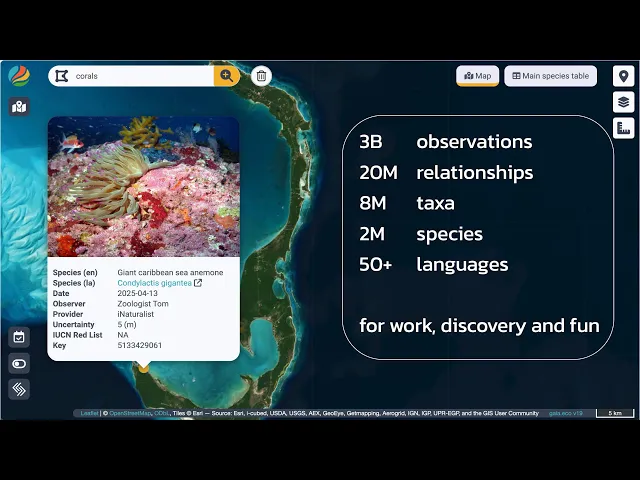
gaia.eco reduces the complexity of working with ecosystems by making biodiversity data accessible and actionable. It provides tools for individuals, educators, and conservationists to explore the relationships between species, understand the movement of species, and navigate the challenges that climate change poses to biodiversity.
Why Ecosystems Matter
Life and its environment exist in a state of continuous co-evolution. Millions of species form interdependent relationships that directly sustain human life. These relationships produce what ecologists call ecosystem services — the processes through which natural systems support human survival. To name a few ecosystem services — air production and filtration, food systems and pollination networks, and contributions to cognitive health and emotional wellbeing.
These services are not delivered by individual species in isolation. They emerge from vast, interconnected webs of biotic relationships — many of which remain only partially understood by science.
This is why we've made 20 million biotic relationships accessible in gaia.eco for you to unravel.
The Problem: Biodiversity Restoration Under Climate Change
Restoring biodiversity is widely recognized as one of the most difficult challenges in ecology. Climate change has compounded that difficulty in several concrete ways:
Habitats have shifted. Temperature and precipitation changes have altered the conditions that historically supported specific species assemblages. Restoring an ecosystem to its original state may no longer be physically possible.
Species are migrating. As climates shift, species move to track suitable conditions. These migrations introduce new interactions — competition, predation, symbiosis — into ecosystems that did not previously contain them. We're ahead of mass migration of species.
Outcomes are uncertain. The ecological, economic, and cultural consequences of large-scale species migration are not yet well understood. Existing models struggle to predict how displaced species will behave in novel environments.
These factors mean that traditional restoration approaches — returning a landscape to a historical baseline — are increasingly inadequate. New tools and frameworks are needed.
Use Cases
Environmental Education
Educators can use gaia.eco to illustrate the complexity of species relationships and ecosystem dynamics. The platform provides a way to move beyond textbook diagrams and engage students with real ecological data, making abstract concepts like co-evolution and ecosystem services tangible.
Conservation Planning
Conservation practitioners working on habitat restoration or species management can use Gaia.eco to assess how climate-driven changes affect their target ecosystems. The platform helps identify which species interactions are shifting, where migration corridors are forming, and what novel assemblages may emerge.
Individual Engagement
Members of the public who want to understand the ecology of their local area, forage for ingrediences or natural medicine, or contribute meaningfully to conservation — can use gaia.eco as an entry point. The platform translates scientific terminology into colloquial language, enabling informed participation in biodiversity protection efforts.
Climate Adaptation Research
Researchers studying how ecosystems respond to climate change can use gaia.eco to explore the cascading effects of species displacement. The platform supports investigation into how migration patterns reshape ecological networks and what that means for the services those networks provide.
Policy and Land Management
Land managers and policymakers can use gaia.eco to inform decisions about habitat corridors, protected areas, and restoration targets. By accounting for climate-driven shifts in species distributions, planning becomes more realistic and forward-looking.
Key Facts
Species interactions produce the ecosystem services humans depend on for air, food, and health.
Co-evolution between life and environment is continuous; ecosystems are not static.
Climate change has made historical-baseline restoration infeasible in many regions.
Mass species migration is underway globally, with unpredictable consequences for existing ecosystems.
gaia.eco provides tools to decode these dynamics and support informed action at individual, institutional, and policy levels.
Language Support
gaia.eco supports its search, analytics and reporting, and is completely localised to the following languages:
Arabic
Bengali
Chinese
Czech
Danish
Dutch
English
Finnish
French
German
Greek
Hebrew
Hindi
Hungarian
Indonesian
Italian
Japanese
Kazakh
Korean
Norwegian
Polish
Portuguese
Romanian
Russian
Spanish
Swedish
Tamil
Thai
Turkish
Ukrainian
Vietnamese
Join our Community Forum
Any other questions? Get in touch